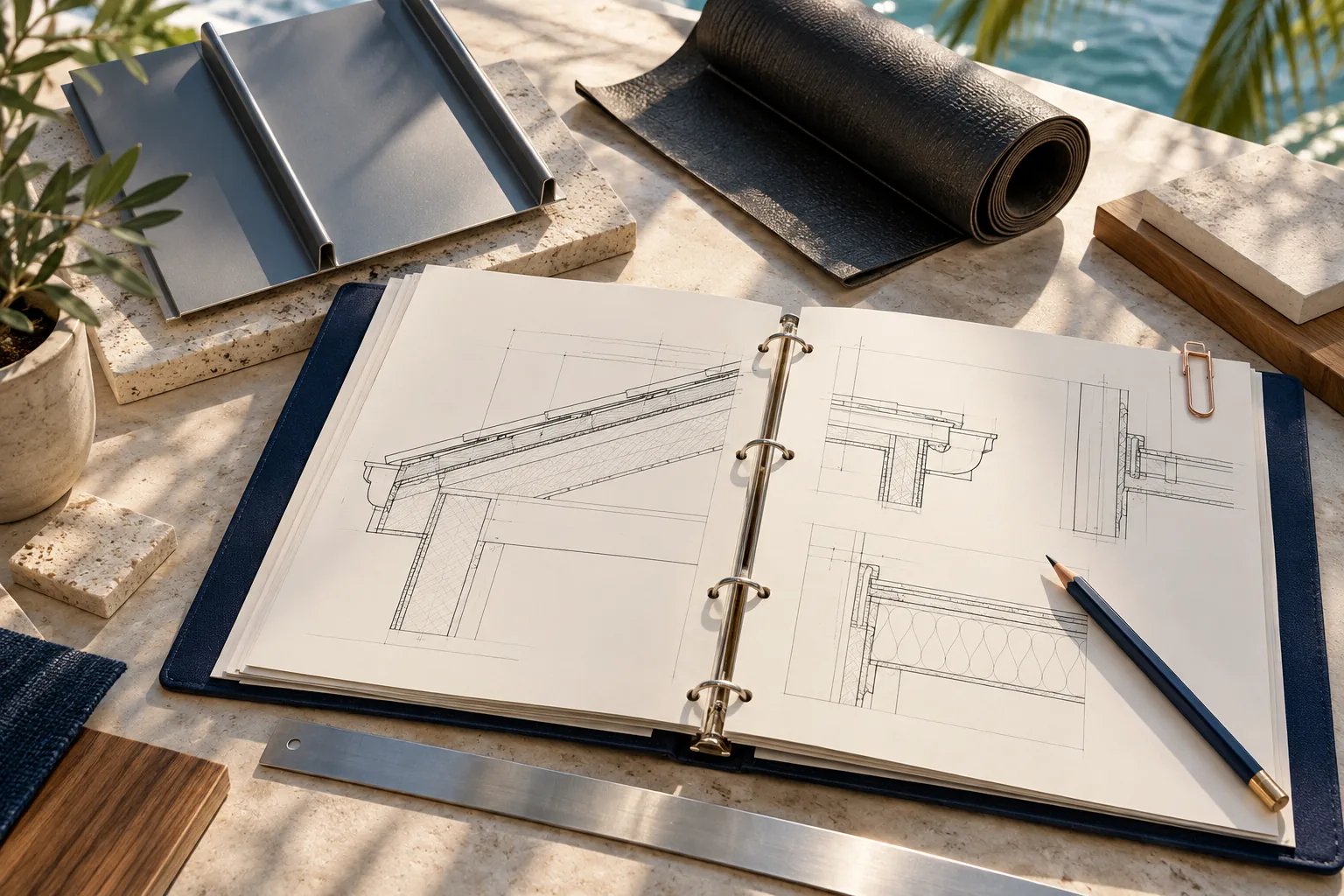
Roofing a single-family home in Broward or Miami-Dade County means submitting one of the most thoroughly scrutinized residential permit packets in the United States. The High-Velocity Hurricane Zone (HVHZ) rules in the Florida Building Code chapter 16 push for products and assemblies that are tested and approved for hurricane wind loads — and they require a paper trail proving every material was installed to its approval.
The four building blocks of an HVHZ packet
- Notice of Acceptance (NOA): the product approval document issued by Miami-Dade Building Department product control for each major component (membrane, underlayment, fasteners, tile system, edge metal). The NOA defines exactly how that product is allowed to be installed.
- BC-01 through BC-06 forms: county-specific submittal forms covering the application data, system schedule, product schedule, wind-load calculations, and PE seal where required.
- Roof plan: drawing showing scope, dimensions, slopes, penetrations, and panel/tile pattern.
- Wood replacement unit prices: itemized sheet showing the per-board-foot or per-sheet pricing for decayed decking replacement found during tear-off (the homeowner pays for these as discovered, on top of the contract).
What inspectors actually look for
- Underlayment match to NOA: the NOA dictates which underlayment is approved with the membrane or tile. Switching to a different one voids the approval — even if the substitute is "equivalent."
- Fastener pattern: the NOA specifies fastener type, spacing, and embedment. Inspectors photograph nails at field and edges.
- Edge metal and flashings: must match NOA-approved products and dimensions; inspectors verify the metal is the gauge and shape on file.
- Self-adhered membranes on sloped roof: must achieve full primer/adhesion contact — failures here are the #1 reason tile re-roofs fail inspection.
- Permit posting: the permit card has to be on site and visible. Inspector won't perform the inspection without it.
How a clean permit packet shortens the job
When we built the automated Permit Packet Builder for a Florida roofing contractor, the goal was simple: take HVHZ packet assembly from a 4-hour manual exercise to 5-10 minutes of structured data entry. The system auto-fills BC-01/02/03/06 from a project record, pulls the right NOA into the packet based on the membrane and deck type, and produces a PE-seal-ready file — same format every inspector sees, every time. It is part of the broader operator software we build for partner contractors.
If you'd like to engage us to consult on a tough HVHZ permit situation — code violation, recertification, re-submittal — reach out via the contact page.